Real time difficulty that adapts to each learner.
NavGurukul, March 2025 to present
3,000+
Learners reached
85%
Adoption rate
35%
Mastery improvement
60%
Less eval time
Context
NavGurukul serves learners from low income and first generation backgrounds across India, including many neurodivergent learners, often on entry level devices and unreliable connections.
The problem
A fixed difficulty test fails in two directions. Learners who are ahead disengage because questions are too easy to hold their attention. Learners who are behind hit a wall they cannot get past and stop trying.
Multiple choice alone also cannot judge reasoning — only whether a final answer matches. This misses learners who think correctly but make a small execution error, and rewards learners who guess well.
The deeper constraint was infrastructural. Whatever was built had to run for users on 2G networks and low end devices, which ruled out any design that depended on a constant connection or heavy client side processing.
Decision and approach
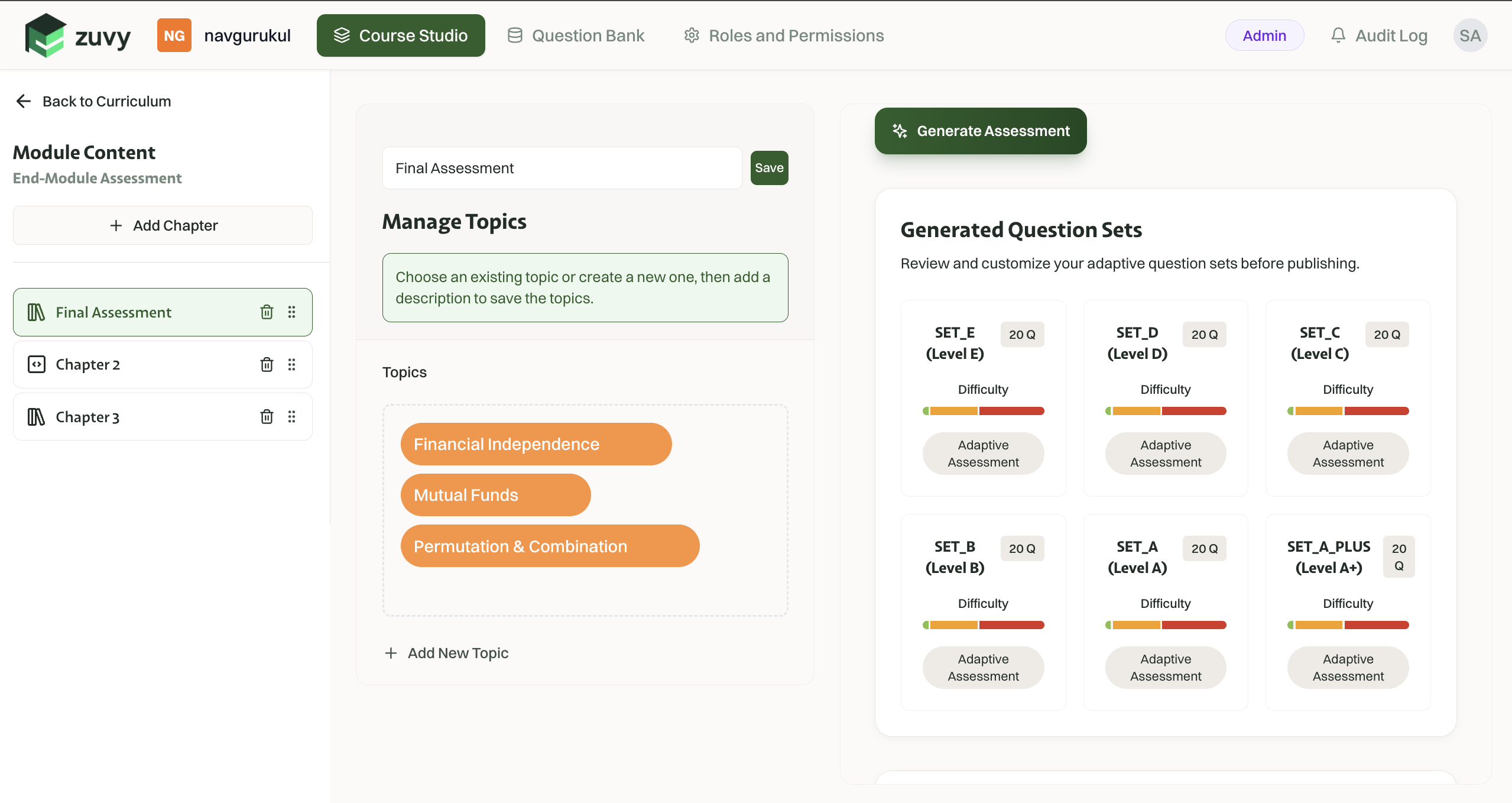
The system needed to do three things at once: adapt difficulty within a handful of questions rather than after a full test cycle; evaluate multiple answer types on reasoning rather than only correctness; and keep working when the connection does not.
Adaptive logic
Starts each learner at mid level difficulty, then moves up or down by one level per question based on performance. Topic rotation is enforced so the system doesn't over index on one area, and deduplication ensures no question repeats within a session. Difficulty correction happens within three questions.
Answer evaluation
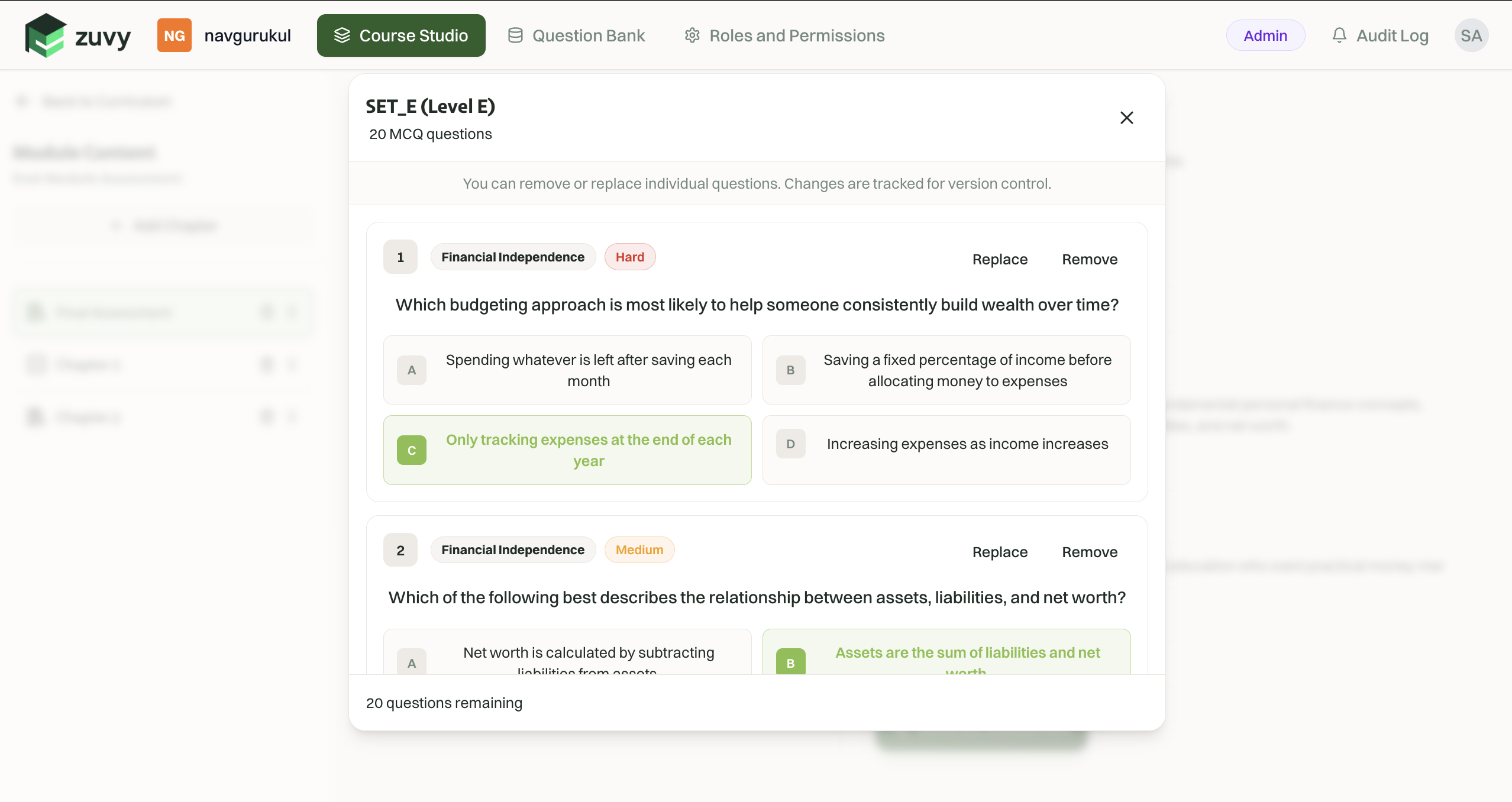
Answers are routed by type. Multiple choice is scored instantly. Code submissions go through layered analysis covering syntax, logic, and efficiency rather than output matching alone. Open ended responses are evaluated against a rubric for conceptual understanding, using Gemini 2.5 Pro, with Perplexity Sonar validating generated content against live sources.
Offline first
Answers are stored locally and synced in the background when connectivity returns. The next few questions are prefetched and cached ahead of time, so a dropped connection does not interrupt the assessment itself.
Build & proof
The result is a system that evaluates answers in well under a second and returns feedback in under two seconds end to end, run on cloud infrastructure sized to serve thousands of concurrent learners at a cost proportionate to a nonprofit's budget rather than an enterprise one.
Question generation, evaluation, and feedback synthesis are handled as separate, independently scaling components, so a spike in one does not degrade the others.
<1s
Answer evaluation time
<2s
End to end feedback
3,000+
Learners on Zuvy Finishing School
2026
India AI Impact Summit casebook
“Assessment stopped assuming a stable connection, a capable device, and a single right way to think through a problem. Built for the hardest case, it ended up working better for everyone it reached.”
Outcome
Work in progress. Prototype validated, development ongoing.
The prototype demonstrated that personalised difficulty can be delivered at scale without any manual configuration per learner. Difficulty routing adjusts automatically based on performance signals, removing the need for a curriculum team to pre-assign tiers or manually review individual learner paths.
Completion rates in testing improved as learners no longer hit difficulty walls that were calibrated for an average rather than for them. The AI handled tier based question routing end to end, which reduced the evaluator workload that previously came from reviewing submissions that were either too simple or too far out of reach to be meaningful.
The system is still being developed. What the prototype confirmed is that the core premise holds: adaptive difficulty is achievable at the infrastructure constraints of the learners it is built for.